
REACTOR: The AI Catalyst for Formulation
Shorten product development cycles with evidential AI and less trial & error.
REACTOR helps you set your acceptance criteria, then prepare, evaluate, and improve the formula, with reasoning traced to literature, patents, and real-world sources you can open. Built by scientists.
Schedule a DemoA live working session on your formulation problem. Bring a question you already know the answer to.
1,300+ researchers on the platform (as of July 2026)
Cosmetics & personal care · Paints & coatings · Polymers & plastics · Adhesives & construction chemicals
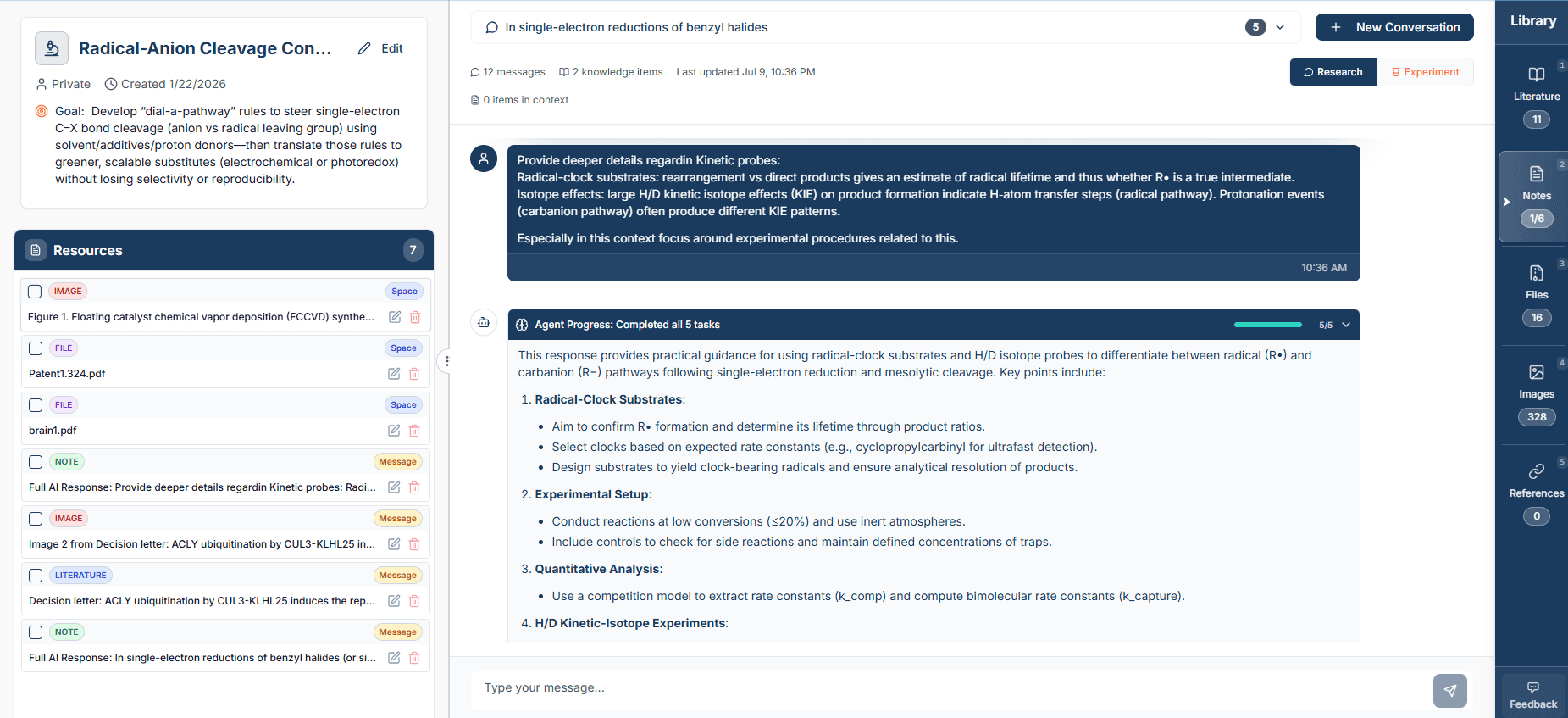
A REACTOR Research Space: project goal, curated resources, and agent reasoning in one workspace.
Trusted by researchers in industry and at leading universities
















The loop every formulator knows
Design. Batch. Test. Fail. Re-read. Re-batch.
One change moves everything
Eighteen interdependent materials in one matrix. Adjust one, and you're re-balancing the rest: performance, stability, cost, and regulatory constraints all at once.
The expensive failures come late
Some problems show up in an hour. The costly ones surface days later, after the batch is gone, the timeline has slipped, and the fix means re-reading everything you already read.
The data is everywhere except in front of you
Supplier marketing without the numbers. Manufacturer sites. Papers that never quite cover your case. The evidence exists. It's just scattered.
The craft is real. The information problem doesn't have to be.
Before you formulate, define what right looks like
REACTOR turns your brief into acceptance criteria: a referenced, testable definition of what the formula has to achieve.
Whatever you make, the same four go in.
- The anchor
- a material your process or your customer has already fixed
- Performance targets
- what it has to hit, and the test that proves it
- Cost and supply limits
- the cost ceiling, and the volumes you can actually buy
- Market, regulatory and claims
- where it sells, and what you need to be able to say about it
What comes out
Acceptance criteria
example: leave-in hair mist
Sprays as a fine, even mist
target viscosity band · refs 3, 7
No phase separation on shelf
12 weeks at 40 °C · refs 2, 5
Cost fits the target margin
single supplier quote, confirm
+6 more criteria · 14 references
See REACTOR on screen
Your criteria stay in the project, so every candidate, substitution and diagnosis is judged against the same standard.
Formulating something else? See all industries
Formulation. Reformulation. Problem solving.
With your criteria set, the work itself is one of three jobs. Ask a formulation question and REACTOR engages its dedicated Formulation Agent: an agentic workflow for each job, measured against the criteria you already agreed, grounded in sources you can open.
The question you bring
“Suggest a preservative system for a high-water-content gel. Natural positioning, EU market, pH 5.2.”
Plain language. Your constraints, your market, your formula.
The Formulation Agent at work
1/5- 1Starts from your criteria
The targets and limits you already agreed, carried straight into the work.
- 2Plans the search
- 3Gathers grounded evidence
- 4Reasons like a formulator
- 5Cites everything
What you walk away with
A referenced starting point instead of a blank page: candidate systems, starting points from precedent, and the sources to defend them.
Along the way, the agent helps you cover
Your formulas stay yours. They are not used to train our foundational models.
One project, five moments on screen
A worked sunscreen photostability brief inside REACTOR: from the first referenced answer to a regulation change caught by web search. Tap any screen to read it up close.
Where formulation teams use it
The same evidence-first workflow, applied to your chemistry.
Cosmetics & Personal Care
Ingredient precedent, supplier documentation, and regulatory texts as cited sources, for formulators who have to defend every choice.
Paints & Coatings
Composition–processing–performance reasoning across resins, dispersions, and surfactant systems.
Polymers & Plastics
Additive packages, compatibility, and stabilizer systems, reasoned from published evidence and verified property data.
Adhesives & Construction Chemicals
Adhesive, sealant, and admixture chemistry, where purpose-built tools are scarce.
Not listed? The same workflow applies to any formulated product. See all industries.
Schedule a DemoWhat you get, today
Every capability below is live in REACTOR now. Nothing on this page is a roadmap promise.
Acceptance criteria
The first step. Your brief becomes a referenced, testable definition of what the formula has to achieve and what it has to avoid, researched against verified material data, patent precedent and current supplier and regulatory sources. Everything after it is judged against it.
Formulation Agent
Reasoning support, not a black-box recipe. A dedicated agent helps you prepare, evaluate, or improve the formula you're working on, and shows its work at every step.
Evidence & referencing
Every output is sequentially referenced. Open the source behind any claim: literature, patents, supplier documents.
Ingredient & property data
Compound data, properties, and safety information retrieved from PubChem. Verified, not generated.
Patent context
Agentic patent discovery from your research context: precedent, prior art, idea validation. (Supports discovery, not legal or freedom-to-operate advice.)
Real-world sources that persist
Datasheets, supplier pages, and regulatory documents pulled in during reasoning and saved as re-queryable References that don't disappear.
Project memory
What this project taught you stays in the project. Sources, notes, and findings remain queryable for the next iteration and the next person.
Built for skeptics
REACTOR was built by scientists who were tired of confident nonsense.
Every claim referenced. Open the source yourself.
Chemical data checked against PubChem, not generated.
Uncertainty stated and missing context requested, not papered over.
Founded by a physical chemist, a computer scientist, and a computational neuroscientist.
REACTOR won't run your experiments.
It grounds the decisions between them, and it tells you when the evidence is thin.
Your formulas
stay yours.
Formulations are trade secrets. REACTOR is built around that reality. The details are public in our AI Data Policy.
- ✓
Your data and your IP stay yours
Everything you upload or create in REACTOR (formulas, files, notes, findings) remains your property, with full visibility and control.
- ✓
Not used to train models
Your private research data is not used to train our foundational models. They learn from public scientific datasets, not from your uploads.
- ✓
Private, isolated workspaces
Your Research Spaces are accessible to your organization only. Your data is never shared with other customers.
- ✓
Encrypted and access-controlled
Data is encrypted in storage and in transit, with role-based access control and audit logging on every access.
- ✓
You can leave with everything
Export your data whenever you want, and request deletion when you go. Ownership includes the exit.
What R&D teams say about Elementics
“I tested REACTOR's capabilities to provide valid safety protocols on an experimental process, not only did it outperform other tools, it flagged essential actions that were otherwise missed.”
“…to my delight I've received comprehensive answers which I can immediately use in my further research.”
“REACTOR makes it easier to organize, access, and build research data to perform good and efficient research.”
“Your platform was genuinely helpful for structuring materials… I even leaned on the AI for a quality check.”
“I've really enjoyed using the Elementics.ai research platform! The interface is clean, intuitive, and aesthetically pleasing, making it easy to navigate large amounts of information. One of its biggest strengths is how it helps organize the scientific literature and visualize different research branches, allowing me to keep track of related topics, surveys, and emerging directions. It has been a valuable tool for exploring new areas efficiently and maintaining a structured overview of the research landscape.”
“I tested REACTOR's capabilities to provide valid safety protocols on an experimental process, not only did it outperform other tools, it flagged essential actions that were otherwise missed.”
“…to my delight I've received comprehensive answers which I can immediately use in my further research.”
“REACTOR makes it easier to organize, access, and build research data to perform good and efficient research.”
“Your platform was genuinely helpful for structuring materials… I even leaned on the AI for a quality check.”
“I've really enjoyed using the Elementics.ai research platform! The interface is clean, intuitive, and aesthetically pleasing, making it easy to navigate large amounts of information. One of its biggest strengths is how it helps organize the scientific literature and visualize different research branches, allowing me to keep track of related topics, surveys, and emerging directions. It has been a valuable tool for exploring new areas efficiently and maintaining a structured overview of the research landscape.”
The questions formulators ask us
Is this another formula generator?
No. REACTOR is reasoning support with sources. It helps you prepare, evaluate, and improve the formula you're working on, and shows you where every suggestion comes from. You stay the formulator.
Does it decide the targets for me?
No. You set the criteria. REACTOR researches and grounds them, shows the evidence behind each one, and says where that evidence is thin. You edit and approve before any formulation work starts. Your fixed constraints stay yours; only the researched parts carry sources.
How is it different from ChatGPT?
REACTOR is chemistry-native: it verifies chemical data against PubChem, keeps a persistent referenced workspace, and marks uncertainty instead of papering over it. Generic chat optimizes for plausibility; formulation work needs evidence.
We already have an ELN.
Different job. Your ELN records what happened; REACTOR helps decide what to do next. They coexist. REACTOR fits alongside your existing tools.
Why a demo instead of a free trial?
Because the fastest way to evaluate REACTOR is on your own problem. The demo is a working session: we set it on a formulation question you bring (ideally one you already know the answer to) and you open the sources behind every claim yourself.
Does it replace bench validation?
No, and it will tell you so itself. REACTOR won't run your experiments. It grounds the decisions between them.
Bring us a real formulation problem.
The best way to evaluate REACTOR is on a question you already know the answer to. Schedule a demo and we'll work through your formulation workflow live, with sources you can open.
- Turn one of your briefs into acceptance criteria, live
- See REACTOR on a real formulation workflow, not a canned script
- Ask it the questions you'd ask a colleague
- Check exactly where every answer comes from
Schedule a Demo
Tell us what you're formulating. We'll run the session on a problem like yours, live, with sources you can open.